How to Build a Functional Desk Setup in a Room Under 9 Square Meters
Most desk-setup advice assumes a spare room. This is for the room that's actually 2.7m × 3.2m or smaller — the math that determines what fits, and three layouts that work without feeling like storage.

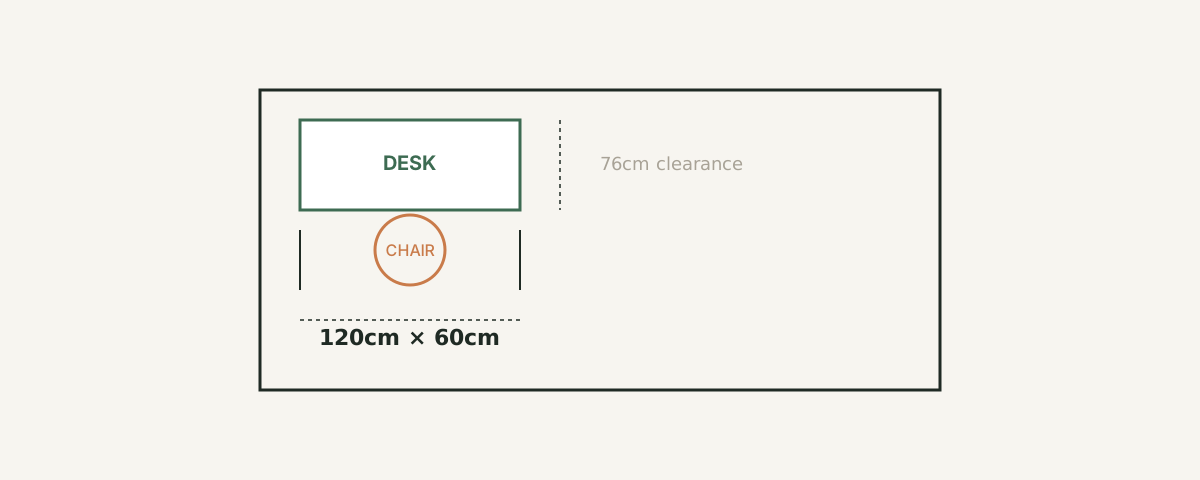
The real constraint isn't floor area — it's clearance
A room measuring 9m² sounds tight, but the actual limiting factor is rarely total square meters. It's whether you have 76cm of clearance behind your chair to stand up and push back, and whether a door or closet swing eats into that space. Measure clearance before you measure the room.
Start with a tape measure and three numbers: the wall length where the desk will sit, the depth available from that wall to the nearest obstruction, and the swing radius of any door within 1.5m of the desk position.
Minimum clearances that actually matter
| Clearance | Minimum | Comfortable |
|---|---|---|
| Behind chair, for standing/sitting | 61cm | 76cm |
| Desk depth (front to back) | 50cm | 65cm |
| Walking aisle beside desk | 55cm | 70cm |
| Knee clearance under desk | 45cm | 60cm |
The "minimum" column is survivable but tight enough that you'll bump the wall or a shelf weekly. The "comfortable" column is what you should target if the room allows it. Below minimum, plan a desk that folds or a layout where the desk isn't a dead-end (see Layout 3 below).
Three layouts mapped to common room shapes
Layout A — Along the long wall (rooms wider than 2.4m)
Push the desk against the longest unbroken wall. This is the default for a reason: it uses the wall's full length without intersecting walking paths. A 120cm × 60cm desk fits comfortably in a wall run of 150cm or more, leaving room for a narrow shelf unit beside it.
Layout B — Corner-angled (rooms under 2.4m wide)
In a genuinely narrow room, a corner desk uses the one section of floor that's otherwise dead space — the corner itself. A corner unit with 70cm arms on each side gives roughly the same usable surface as a 120cm straight desk while leaving the rest of the room's walking line clear.
Layout C — Wall-mounted folding desk (rooms under 7m² or shared-use rooms)
For a bedroom that needs to stop being an office at night, a wall-mounted folding desk with a 40cm folded depth reclaims the floor entirely. The tradeoff is weight capacity and stability — covered in our folding desk stability guide.
Choosing desk size for what you actually do
Desk width should be sized to your monitor setup, not the other way around. A single 24" monitor needs about 90cm of width to sit centered with a keyboard in front of it and a mouse pad beside it. A 27" monitor needs closer to 100cm. If you're considering two monitors, see our single vs. dual monitor space tradeoff guide before committing to a wider desk than the room supports.
Before you buy: a five-minute check
- Measure wall length where the desk will go, not the room's longest wall
- Measure depth from that wall to the nearest obstruction at chair height (not floor height — radiators and windowsills often protrude differently at 45-70cm than at floor level)
- Check door swing radius if a door is within 1.5m
- Confirm an outlet exists within cord length of where the desk will sit, or budget for an extension
- Decide chair clearance behind the desk before finalizing desk depth — this is the number that gets skipped most often
A worked example: fitting a 2.6m × 2.9m bedroom
Take a room with a bed along one wall, a closet door that swings out 70cm, and one remaining wall measuring 2.6m. After subtracting the door's swing radius and a 10cm safety margin, the usable wall run drops to roughly 1.8m — still enough for Layout A with a 120cm desk, but only if the desk sits at the far end from the door, not centered on the wall. Centering it would have looked better in theory and left the chair directly in the door's swing path in practice. This is the kind of conflict a flat square-meter number never reveals, and it's why we suggest measuring clearance zones individually rather than just confirming the room "is big enough" on paper.